In India, law enforcement regarding women’s safety operates on a reactive rather than proactive basis. A deep analysis of violent crimes against women reveals a "Premonition Pattern": while these incidents may appear to be isolated events, the vast majority of victims had previously been subjected to threats, harassment, or physical abuse by the perpetrators. In many cases, victims knew of the coming threat, and alerted family, friends and even the police, before the incidents happened. However, the absence of a proactive, hyper-local framework for women's security alerts and rescue management allows these incidents to occur despite the early warnings.
Many women facing threats in workplaces, schools, or their own neighborhoods hesitate to file formal complaints based only on the feeling of future danger, because the existing system is ill-equipped for preventive proactive protection. Because of this, critical-but-preventable crimes occur, and the police administration fails to take action until it’s too late.
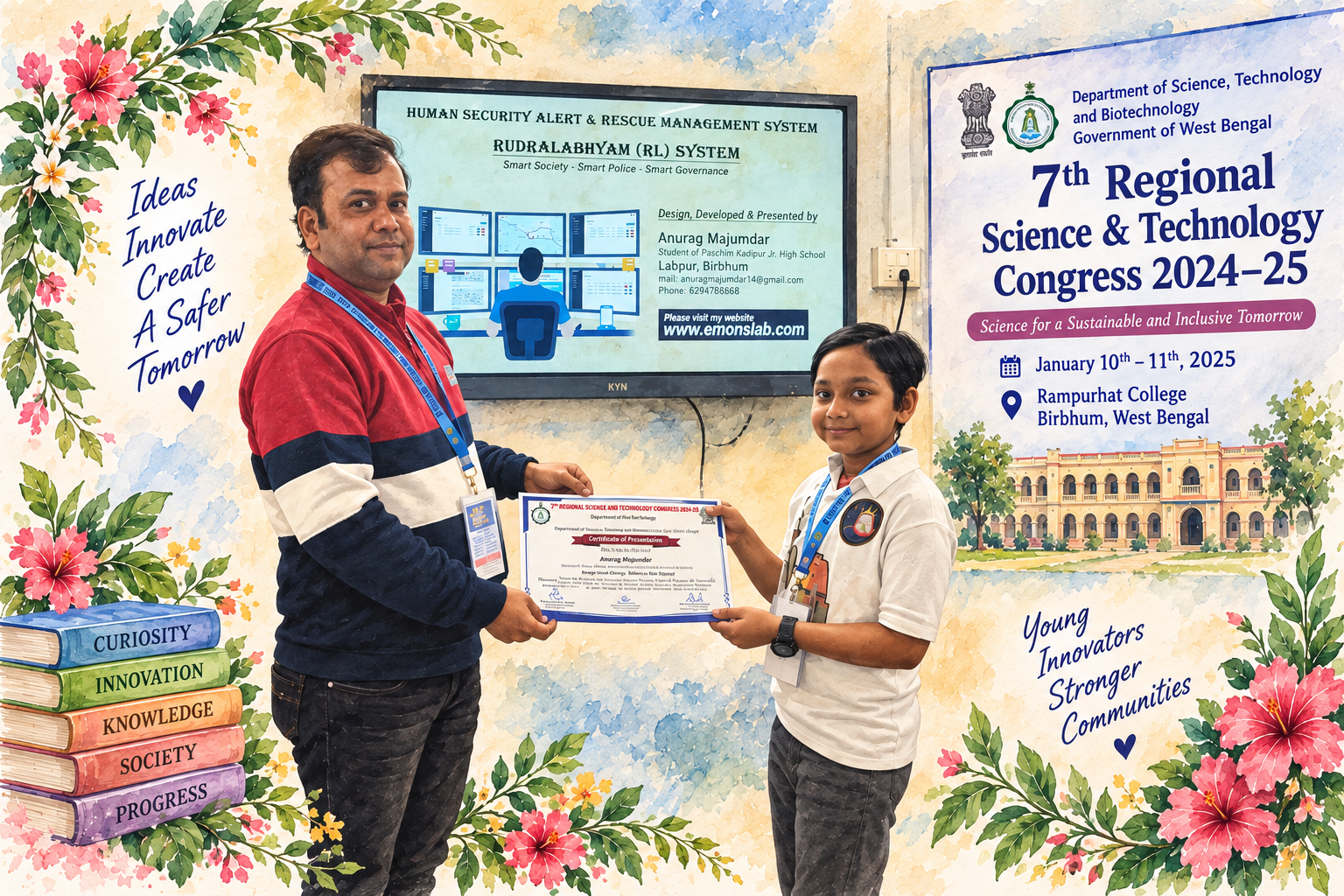
The Rudralabhyam (RL) System is a police-administered, hyper-local rescue management framework designed to solve this crisis. It integrates a portable IoT tracking device (RL Device), a web-based response platform (RL Web Application), a station-level alert box (RL Alert Box) and two mobile applications (RL Rakshak and Rudralabhyam Mobile apps). Women facing assessed threats are exclusively issued the RL Device by local police after submitting a formal application about the perceived threat.
When a victim presses the panic button in an emergency, the RL Device begins transmitting live location information and the corresponding ID to the RL Web Application. The RL Web Application then identifies the nearest police station and activates the corresponding RL Alert Box. Which alerts the police, and a responding officer (RL Rakshak) begins the rescue operation; which is then tracked via the RL Rakshak Mobile App and the RL Web Application. This project has been successfully demonstrated as a working prototype and in the next phase, low-bandwidth communication and indigenous NavIC technology will be integrated. The RL System is not a competitor to the National Initiative ERSS-112, but a hyper-local emergency layer on top of ERSS-112.

 ONE BUTTON · ONE SIGNAL